Key takeaways
- Minimum order quantities (MOQs) for custom-printed coffee packaging vary with printing method, bag format, and material, with digital printing and LED printing starting at 2000 and 200, respectively.
- Digital printing with liquid electrophotography (LEP) eliminates the need for printing plates, allowing MTPak Coffee to offer custom coffee packaging from as few as 200 units.
- Roasters not yet ready for full customisation can start with stock bags plus stickers or stamps, or with single-colour logo print. Then move to custom-printed coffee packaging once volume and brand identity justify it.
Packaging is one of the most powerful branding tools available to coffee roasters. Yet for many, the question of minimum order quantities (MOQs) can make custom-printed coffee packaging feel out of reach. How many bags do you actually need to order? And what drives that number in the first place?
This article explains how custom-printed coffee packaging works and what roasters should know before they first order. It also covers how to keep the process cost-effective, whether you are starting out or scaling up.
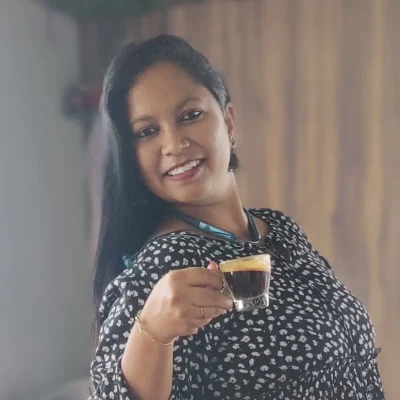
For Hai Coffee Roasters in Thailand, the journey began with materials and values rather than volume. To find out what roasters should weigh before their first order, I spoke to co-founder Makhawan Kijyakanont. Read on for his insights.
Subscribe to our weekly newsletter
Sign up
How does custom-printed coffee packaging work?
Custom-printed coffee packaging works by transferring a roaster’s design onto a chosen substrate, and the printing method largely decides cost, lead time, and minimum order quantity.
When Makhawan began exploring custom packaging, a combination of values and practical constraints shaped the process from the start.
“Before we started this project, we looked for a coffee bag that is made of as much eco-friendly material as possible,” he explains. “Finally, we found it – a coffee bag made of paper and lined with food-grade material that can be decomposed, yet protects the coffee beans.”
The choice of printing technology sits at the centre of how custom-printed coffee packaging gets made, and how accessible it is. Traditional methods like flexographic printing use raised image plates and custom-built rollers to transfer ink onto substrates. Because suppliers must manufacture new plates for every design, they set high MOQs to recoup those setup costs. Rotogravure works the same way, relying on custom-made cylinders, so manufacturers price it for large runs.
For smaller roasters, an MOQ of 10,000 units for these traditional methods rules out shorter lead times and smaller orders.
Digital printing works differently. The process relies on liquid electrophotography (LEP), a form of digital printing that applies water-based inks to a range of sustainable substrates. These substrates include recyclable and biodegradable materials such as kraft paper, rice paper, polylactic acid (PLA), and low-density polyethylene (LDPE).
Because the process needs no plates, roasters can send designs straight to the press and change them between runs at minimal cost. That structural advantage translates directly into lower MOQs.
When choosing a printing partner, Makhawan says his priorities reflected both brand and operational needs. “We first look at sustainable materials and also the quality of the finished product and the flexibility of MOQs,” he says.
What should roasters know before ordering custom-printed coffee packaging?
Before ordering custom-printed coffee packaging, roasters should understand that MOQ, cost per unit, lead time, design flexibility, and sustainability all shape the decision, not price alone.
MOQ can come as a shock to roasters exploring custom printing for the first time. Makhawan explains:
“Of course, it is very challenging, especially when you first start with a very low budget, but still want your packaging to be outstanding and recognisable. I would consider this to be a part of marketing. We would rather start with something meaningful than with what saves more on costs. We are a new coffee brand; we need people to see us.”
Across the industry, several factors drive MOQs: printing method, bag format, material specification, and whether the design needs custom tooling. Most packaging manufacturers set a MOQ, and it rarely falls below 10,000 units for fully customised designs.
Traditional processes, such as offset or flexographic printing, have high MOQs due to setup costs, including printing plates, dies, and machine calibration. Many custom manufacturers in the USA ask for minimum orders of 5,000 to 10,000 units.
This is where MTPak Coffee’s investment in new digital printing infrastructure changes the equation. Our new digital LED printer can produce up to 300,000 sheets per month. We now offer MOQs of 200 pieces, with a one-week turnaround after design approval. For smaller or growing roasters who cannot yet commit to large print runs, this removes one of the biggest barriers to entry.
But MOQ is only one piece of the picture. Cost per unit, lead times, design flexibility, and sustainability credentials all factor into the decision. For Makhawan, the bigger-picture thinking was clear from the beginning. His approach prioritised meaningful brand presence alongside eco-conscious materials – a combination that shaped every part of his packaging decision.

How can roasters make custom-printed coffee packaging more cost-effective?
Roasters make custom-printed coffee packaging more cost-effective by ordering based on real usage data, simplifying designs, standardising formats across SKUs, and reusing artwork between seasons.
As Makhawan’s brand has grown, his approach to ordering has become more data-driven. “After we have scaled our business and collected data on how many bags we use, we easily break down the order placement to match our usage to protect the shelf life of the materials due to its 100% biodegradable. Moreover, the cost seems to be less when we order larger quantities,” he says.
This reflects a principle the industry understands well: as order volume rises, cost per unit falls. A custom sleeve run of 500 pieces might cost $0.80 to $1.00 per unit, while a 30,000-piece order brings that figure down sharply.
Roasters can also cut costs by simplifying design complexity, standardising bag formats across SKUs, and reusing existing artwork between seasons or product lines.
For roasters not yet ready for fully custom-printed coffee packaging, stock bags with stickers or stamps remain a practical entry point. Low MOQ options usually cover only the most basic pouch types, such as plain stock bags with single-colour logos. New technology has widened those options.
The move to full customisation makes sense once volume is consistent and brand identity is firmly established. At that point, the cost-per-unit advantage outweighs the flexibility of stickered stock bags.
Makhawan explains that, when they first weighed up alternatives, “they looked at different bags in the market that can protect our roasted coffee bean made of eco-friendly materials” before committing to full customisation.
Custom-printed coffee packaging no longer asks roasters to commit to thousands of units before they have a market. Digital printing removes the plate-cost barrier, and MTPak’s new digital LED printer offers MOQs as low as 200 pieces. Quality packaging is now genuinely accessible at every stage of growth. The most important step is understanding what drives MOQs, and finding a printing partner whose technology and values align with where your brand is headed.
At MTPak Coffee, we support roasters at every stage in choosing the right packaging for their volumes, release cadence, and brand ambitions. For more information about custom-printed coffee packaging, contact our team.
FAQs
What is the minimum order quantity for custom-printed coffee packaging?
It varies by printing method, bag format, and material. Traditional flexographic and rotogravure runs often reach 5,000 to 10,000 units, while digital printing – at MTPak Coffee – can start from as few as 200 pieces.
Why does digital printing allow lower minimum order quantities?
Digital printing uses liquid electrophotography, which needs no printing plates. Roasters can send designs straight to the press and change them between runs, so suppliers can offer far smaller orders.
When should a roaster switch from stock bags to custom-printed coffee packaging?
The switch makes sense once order volume is consistent and brand identity is well established. At that point, the lower per-unit cost of full printing outweighs the flexibility of stickered stock bags.